

The European Union is once again confronting one of its biggest challenges—migration. Following the unprecedented migrant surge into Spain’s North African enclave of Ceuta on 30 July 2026, migration has returned to the top of the EU political agenda, raising new questions about the future of the Schengen Area, border controls, asylum rules, and migrant return policies.
What Happened in Ceuta?
On 30 July 2026, more than 70,000 irregular migrants entered the Spanish enclave of Ceuta in a single day.
According to Euronews, this exceeded the total number of irregular border crossings recorded across all other EU external borders during 2026 up to that point.
The incident triggered a political crisis in Spain and prompted several EU member states to demand stronger external border protection, faster deportations, and stricter migration management.
Schengen Under Pressure
One of the immediate consequences was renewed pressure on the Schengen Area, Europe’s passport-free travel zone.
Italy temporarily reintroduced air and maritime border checks with Spain, citing security concerns following the Ceuta crisis. Spain responded with reciprocal border controls, and both countries later agreed to extend these measures by an additional 15 days.
The debate quickly spread across Europe. Countries including Denmark and Finland questioned whether Spain should temporarily lose its Schengen privileges, while several governments called for stronger internal border monitoring.
As of late August 2026, nine EU countries—Germany, Spain, Italy, Denmark, Austria, the Netherlands, Poland, France, and Sweden—along with Norway, had temporary border controls in place due to concerns over irregular migration and security.
Although Schengen remains fully operational, the increased use of temporary border checks highlights growing political tensions over migration management.
EU Migration Pact Faces Its First Major Test
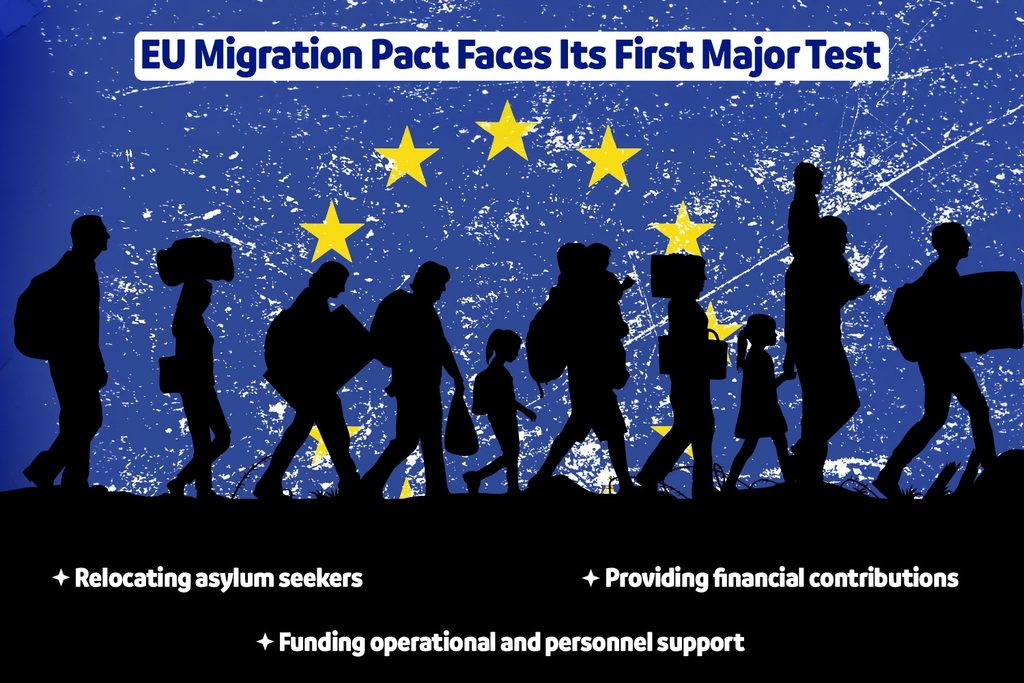
The crisis also became the first major challenge for the EU Migration and Asylum Pact, which entered into force on 12 June 2026.
The pact introduced a mandatory solidarity mechanism requiring EU countries to support frontline states through one or more of the following:
- Relocating asylum seekers
- Providing financial contributions
- Funding operational and personnel support
For 2026, 8,878 asylum applicants from Spain, Italy, Greece, Cyprus, and Malta are scheduled to be relocated across other participating EU countries.
However, relocation applies only to asylum applicants and people already granted protection—not to most of the Moroccan migrants who entered Ceuta irregularly, many of whom are expected to be returned to their country of origin.
The system is already showing signs of strain, with several member states seeking exemptions or requesting additional compensation beyond the framework established under the pact.
New Focus on “Return Hubs”
Another major topic dominating EU discussions is the creation of return hubs.
Under the EU’s newly adopted migration return regulation, member states may establish agreements with non-EU countries to host deportation centers where irregular migrants can be transferred while awaiting return procedures.
According to Euronews, countries including Germany, Austria, Denmark, Greece, and the Netherlands are exploring partnerships with nations such as Uganda and Rwanda.
Supporters argue that return hubs could improve the efficiency of deportations. Critics, however, have raised concerns about legal accountability, human rights protections, and whether such facilities comply with European and international law.
Legal experts also expect future court challenges once the first return hubs become operational.
What Does This Mean for Schengen Visa Applicants?
For travellers planning to visit Europe, the current developments do not affect the validity of Schengen visas.
However, travelers should be aware that
- Temporary internal border checks may continue between certain Schengen countries.
- Passport and travel document inspections may take place even within the Schengen Area.
- Visa processing and entry requirements remain unchanged under current EU regulations.
The European Council is expected to discuss migration and Schengen reforms further during its meetings in October 2026, making this an important policy issue to watch in the coming months.
Final Takeaway
The Ceuta crisis has exposed the ongoing challenges facing Europe’s migration system.
While the Schengen Area remains in place, the renewed use of internal border controls, debates over migrant solidarity, and proposals for return hubs indicate that migration policy will remain one of the EU’s most significant political priorities throughout 2026.
For travellers and Schengen visa applicants, there is currently no change to visa rules, but staying informed about evolving border measures is advisable as EU leaders continue negotiations on the future of migration management.
Original Sources: https://www.euronews.com/my-europe/2026/09/01/schengen-strained-solidarity-broken-and-return-hubs-disputed-eu-struggles-again-with-migra